Track Threads Views and Followers Separately with a 4-Week Experiment
Key Takeaway
Start today with one reader, one problem, an updated profile and one post that addresses that problem. Say your topic is grocery shopping and simple home cooking for people living on their own for the first time.

Mention that in your profile, then open with a way to use frozen vegetables. After that, track each post's views and responses, and keep them apart from changes in your account's overall follower count. Let those records tell you what to keep doing.
Treat the posting frequency, measurement times and comparison criteria here as a way to start an experiment, nothing more. They aren't a formula for every account, and they aren't the recommendation algorithm's rules. Change them to fit your schedule and topic, but write down what you changed.
Meta's official guidance gives two starting points: conversation and tracking. It recommends posts that start conversation and original content on Threads, and says Insights lets you review views, replies, reposts, quotes and changes in follower count. The post examples, 4-week comparison table and daily 20-minute plan below are practical suggestions from this article, not a growth formula validated by Meta. Meta's Threads educational guidance, Meta's Insights guidance
🎯 Choose your reader and topic, then update your profile
Decide who you want to reach and what you'll share before anything else, and your profile intro and your posts will line up more easily. Write your answers in this order.
- Narrow down your reader. “Someone living alone for the first time who prepares a meal for one after work” is more specific than “someone interested in cooking.”
- Pick a problem they have right now, and put it in their words: “I have ingredients left over,” “I don't have time to cook,” “It's hard to estimate my grocery costs.”
- Set a scope you can cover consistently. Pick two or three topics, say meals made with a few ingredients, storing ingredients, or shopping in small quantities. Skip professional health or nutrition advice you couldn't explain yourself.
- Boil it all down to one sentence: “I share grocery shopping and home-cooking ideas to help people living alone for the first time prepare meals with a few ingredients.”
- Last, update your name, introduction and any necessary links in that order. Make the name easy to recognize, and write an introduction that says who it's for and what they can expect to see. If you add a link, make sure it leads somewhere related to the topic you've described.
Here's a completed example.
Name: Meals for One Journal
Introduction: I share simple home-cooking ideas for people living alone for the first time. Expect meals made with a few ingredients and tips for shopping in small quantities.
Link: Only if you have your own grocery list or a related page to share
If someone reading this introduction can picture the posts coming next, it's doing its job. After you've published a few, check whether it matches the topics you actually cover most often. If your topic has shifted, change the introduction too.
✍️ Alternate between four post formats with different purposes
The examples below all speak to the same reader. Each opens with the reader's situation, and the body gives one point they can take in at a glance. You don't have to force a question or a request to follow into every post.
Informational: Show a method readers can try right away
If figuring out dinner after work feels overwhelming, try starting with a meal made from eggs and frozen vegetables.
Cook the frozen vegetables in a pan, add the eggs, and stir-fry them together. Got rice? Toss it in, then season with salt or whatever you usually use. You can take out just as many vegetables as you need.
Skip buying lots of ingredients at the start. One combination you can eat often makes grocery shopping much simpler.
The reasoning: the post opens with making a meal after work, then goes straight to ingredients and steps the reader can use. The last sentence ties the recipe back to the grocery shopping problem.
Next post: cover “what to look for when choosing frozen vegetables” or “ingredients that are easy to use alongside them besides eggs.” If people respond, note what they were curious about as possible topics.
Experience sharing: Write about an actual experience
The brackets below are blanks for you to fill in with things you've actually experienced. Nothing to share yet? Write an informational post or a question instead.
When I bought ingredients for meals for one, I struggled with [a difficulty you actually experienced].
So I tried [an action you actually took], and the result was [a change or inconvenience you actually observed]. [Something that varied depending on the situation, or a problem that remained] also came up.
Next time, I plan to try [something you actually plan to try]. If you've been in a similar situation, what do you do?
Why this structure: splitting the difficulty, the action and the result shows readers what they can take from your experience. Add anything that differed from what you expected, since it helps them compare with their own situation. Leave out effects or time periods you haven't confirmed.
Next post: once you've actually tried the next step, write down what you did and what was different. No result yet? Present it as a plan only, like “I'm looking into this approach.”
Comparison: Help readers choose for their situation
If you're deciding between fresh and frozen vegetables for meals for one, try choosing this way.
Fresh vegetables: Consider these when you want them raw, as in a salad, or want to keep their texture. Check how much you're buying and how long it will keep.
Frozen vegetables: Consider these when you want to take out and cook only what you need. Preparation and cooking instructions differ by product, so check the packaging.
If you already know what you'll cook this week, pick vegetables to suit the dish. If not, start with your storage space and how much you'll use.
Why it's framed this way: the post doesn't crown one option. It shows when each might help and what to check, so readers can choose by how they eat.
Next post: pick one of the two options and go deeper on storage or preparation. You can also let the comments narrow the topic, with questions like “what to check when buying small quantities.”
Question: Learn about your readers' situations
Since you started living on your own, what has been your biggest concern when grocery shopping?
① I have too many ingredients left over
② I don't know what to buy
③ I don't have enough time to cook
④ I have another concern
Just a number is fine, or describe your situation in a line if you'd rather. I'll use your answers when choosing topics for future posts.
Why write it this way: options mean readers don't have to compose a long answer, and leaving room for “another concern” can bring up things you didn't expect. Don't assume readers are uninterested just because there are few replies.
Next post: take one of the responses you actually got and write about a possible solution, linking back with something like “Let's look at the ingredient storage concern raised in the last question.” No responses? Carry on with a problem you plan to cover regularly within your topic.
💬 Tailor replies to what the other person says, rather than promoting yourself
When you reply to someone else's post, read it first, then add one piece of information or one question tied to their problem. The same goes for replies on your own posts.
Say the other person's post reads, “I keep having vegetables left over when I buy them for meals for one”:
A less helpful reply
I live alone too! My account has lots of great tips, so follow me and take a look 😊
It leads with promotion and gives them nothing that helps with their question.
A reply that continues the conversation
Frozen vegetables you can portion out as needed might be one option. If you mostly eat fresh vegetables, you could also look for products sold in small quantities. Do you usually eat them cooked or raw?
It offers options based on the person's situation and asks what might suit them. And don't pressure anyone to answer.
To keep a conversation going, work through these steps.
- Find the concern or question in the other person's post.
- Write a one- or two-sentence response tied to what they said. Don't pretend to know something you don't.
- If you need to know more, add one question that's easy to answer.
- If they reply, answer once more with details that suit what they said. Say they write “I usually stir-fry them”; you could respond, “In that case, you might start by looking at frozen vegetables that are easy to portion out as needed.”
- Stop when the conversation reaches a natural end. Don't repeat the same promotional message in several places, and don't press anyone for an answer.
If someone else's reply gives you an idea for a post, don't reveal their personal details without permission. Address the problem in general terms instead.
🗓️ Compare one thing at a time over 4 weeks
Before you begin, write down your current follower count and whichever metrics you can actually see on your account. Check each post's views at the same point, such as 24 hours after posting, and mark anything you couldn't check as “not checked.” The 3 posts per week below are only a starting point. If that feels like too much, post less often.
Week 1: Record your starting point
- What to do: publish about 3 posts for the same reader on the same topic, and read related posts and leave replies. Already running an account? Keep your usual pace and record the results.
- Hold constant: the reader and topic you chose, and the time you check after posting, as closely as you can.
- What to record: each post's topic, format, day and time, views, any responses you can see, and writing time, plus the number of replies you left and your follower count at the start and end of the week.
- For next week: pick a topic that isn't hard to write about and gives you enough to explain. Note which posts drew questions or specific responses, but don't drop the others because of one post's result.
Week 2: Compare post formats
- What to do: stay on one topic and alternate short explanatory posts with ordered lists. Mark each post's format in advance.
- Keep steady: posting volume, the general scope of your topic, time of day, reply activity and measurement time. Arrange the posts so one format doesn't always land on the same day of the week.
- Record: each post's format, views, available responses and writing time, plus any differences in topic or posting time.
- For next week: weigh readers' responses and the effort each format takes alongside views, then pick a format to keep testing. With few posts or big differences in conditions, don't declare a winner. Run both formats longer.
Week 3: Compare reply activity
- What to do: split several days, posting days included, ahead of time into days for “reading related posts and leaving replies” and days for “taking a break from replying.” On active days, answer what the posts actually say rather than chasing a set number.
- Keep steady: post topics and formats, posting volume and measurement times. And don't let active days and rest days each fall on just one day of the week.
- Record: the actual number of replies and time spent, along with posts, views and responses on those dates, plus the net weekly change in followers.
- For next week: choose the level of activity that gives you useful conversations and fits your time. Numbers may differ between active and rest days, but other conditions may have changed too, so replies aren't proven to be the cause.
Week 4: Choose a sustainable posting volume
- What to do: pick two workable approaches in advance, such as “posting days” and “rest days,” and run each for several days. Write down the dates for each approach and the actual number of posts.
- Keep steady: topics, formats, reply activity, the rough time of day and the time you check after posting. Don't test time of day in the same round.
- Record: days under each approach, number of posts, total views, average views per post, writing time and net weekly change in followers. Flag any unusually high-performing posts separately.
- For next month: look at overall views, the average per post, follower changes and the time you spent managing the account, all together. A period with more frequent posting may show more total views just because it had more posts. If you're getting tired or keeping quality up gets hard, post less often and observe again.
Days of the week, subject matter and account circumstances can all change from week to week. Use the 4-week results to choose your next experiment. Don't treat a weekly change as definitely caused by one thing.
📊 Assess views and followers separately
Views tell you how often a post was viewed, and that's where to start. Check every post at the same point in time and look at both total views and the average per post. With only a few posts, chance can swing the comparison a lot. Views may also include repeat views by the same person, so they aren't a count of distinct people. Check, too, whether one unusually high-performing post pulled the average up.
Net follower growth is your follower count at the end of a period minus the count at the start. It nets out people who followed against people who left, so it isn't the same as new followers alone. It can't tell you which post brought in follows, either: other posts, replies and visits from people who already knew you may also move the count in the same period.
Here's a hypothetical 2-week record for two accounts, for calculation practice. Assume every post's views were checked 24 hours after posting, and follower counts were recorded at the start and end of each week.
| Account and period | Posts | Total 24-hour views | Average views per post | Followers start → end | Weekly net growth |
|---|---|---|---|---|---|
| Account A, week 1 | 3 posts | 900 | 300 | 100 → 106 | +6 |
| Account A, week 2 | 4 posts | 1,600 | 400 | 106 → 110 | +4 |
| Account B, week 1 | 3 posts | 600 | 200 | 200 → 203 | +3 |
| Account B, week 2 | 3 posts | 750 | 250 | 203 → 212 | +9 |
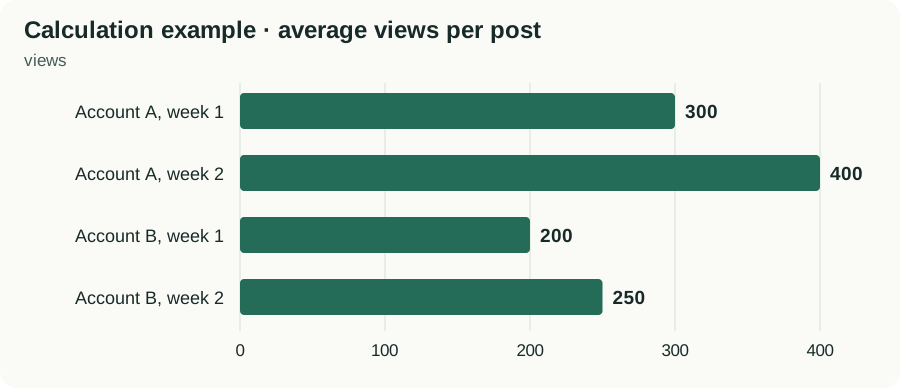
This is a hypothetical record for the table above, not real account results or an expected growth rate. Each post is assumed to be checked 24 hours after publishing. It does not say one account's way of working is better than another's.
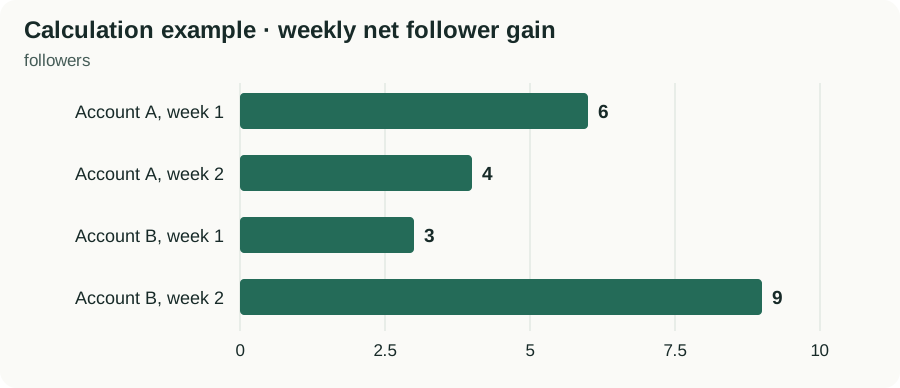
This is a hypothetical record for the table above. It is the end-of-period follower count minus the start count, and does not mean the number of new followers or the effect of a particular post.
Here's the arithmetic.
- Account A's average views per post in week 2: 1,600 ÷ 4 = 400 views. Week 1 was 900 ÷ 3 = 300 views. The number of posts differs between the two weeks, so read the average next to the total.
- Account A's net follower growth in week 2: 110 - 106 = 4 followers. Week 1 net growth was 106 - 100 = 6 followers. Views went up and net growth went down, and these figures can't say why.
- Account B's average views per post and net growth in week 2: 750 ÷ 3 = 250 views, and 212 - 203 = 9 followers. Both beat week 1, which had an average of 200 views and net growth of 3 followers. The table can't show which activity produced the change.
- Comparing the accounts: in week 2, Account A had the higher average views and Account B the greater net growth. Starting follower counts, topics, readers and operating approaches may differ, so use the figures to choose each account's next experiment, not to crown one approach.
Say Account A posted more informational posts in week 2. It could keep the topics that drew views and check whether its profile introduction and post topics fit together. The drop in net follower growth doesn't by itself show that informational posts discouraged follows. Posts that took a long time to write could be revised into shorter versions and compared again. Activities that don't help conversation, like repetitive promotional replies, could be stopped.
Account B could keep covering the topics that prompted specific questions, then try posts answering those questions under similar conditions the following week. One high week of net growth isn't a reason to ramp up posting sharply. Check whether the time commitment is manageable and whether similar responses continue. And don't fill in unavailable figures with estimates.
⏱️ When time is short
If you have 20 minutes a day
- 2 minutes: Go through your notifications and existing replies to see if there's anything you could respond to.
- 10 minutes: Write a post from a topic you jotted down earlier, or draft the next one. You don't have to publish every day.
- 5 minutes: Read related posts and reply to the ones that fit, or answer questions on your own posts.
- 3 minutes: Log when you checked each published post, its views, and how long you worked. No post to log that day? Write down your next topic.
Short on writing time? Spend less of it on replies. At the weekend, look at your follower count from the start and end of the week along with your post records, and pick one thing to change next week.
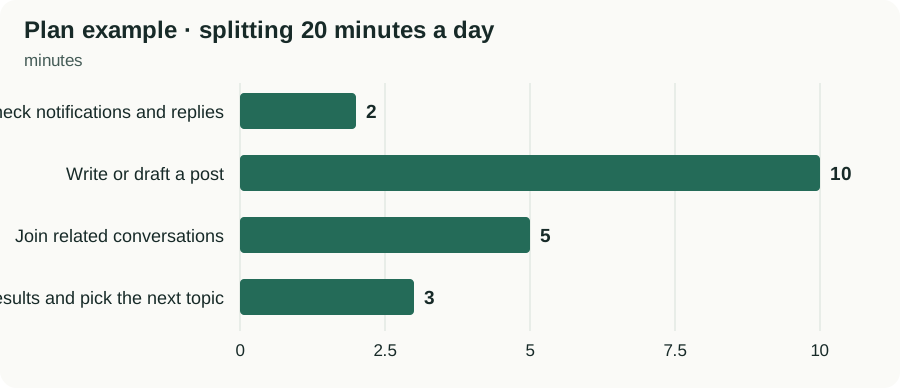
This is the time-split suggestion from the text, not a measurement or a recommended algorithm formula. If writing needs more time, you can adjust the time for other activities.
If you can only work on it 3 times a week
- First day: Go over your earlier records and responses, pick two or three post ideas for the week, then write and publish one post.
- Second day: Answer the replies you got, join related conversations, and publish a second post.
- Third day: Publish a third post, or prepare a follow-up to an earlier one. Record the views at the check time you chose and the weekly follower count. Then pick one change for next week.
If 3 visits make it hard to check every post at exactly 24 hours after publication, pick an interval ahead of time, keep it as consistent as you can, and write down when you actually looked. When check times differ, factor that in as you compare numbers. Busy week? Publish fewer posts and carry on the week after.
✅ Checklist to use today
- [ ] I've written down my reader and the problem I want to solve in one sentence.
- [ ] I've picked two or three topics to cover.
- [ ] My profile name and intro say who the reader is and which topics I cover.
- [ ] I've got one post ready that readers can understand or answer right away.
- [ ] If I wrote about an experience, it includes only what I went through and confirmed myself.
- [ ] I read a related post and left a reply that fit.
- [ ] I noted my current follower count and when I'll check after posting.
- [ ] I picked a posting frequency and time commitment I can keep up this week.
Frequently Asked Questions
If my Threads views go up, will my followers go up too?
Not automatically. Log views per post and the account's net follower growth over a period as two separate things, then look at which posts may have led to follows.
Are the 4-week experiment's criteria official rules from Meta?
No. The posting frequency, measurement times and comparison criteria are an experiment this article proposes. They're neither a formula for every account nor a set of recommendation algorithm rules.
Does the 4-week tracking table show a real account's performance?
No. Every record in the table and charts is hypothetical, there to show the method rather than real performance or a growth projection.
Sources & Verification Date
- Meta — Threads Educational Guidance (Finding Your Community and Educational Insights) · Verified
- Meta — New Threads Features for Creators and Businesses (Insights) · Verified
All materials have been verified from official announcements and may have changed since verification.